 Solidus
More
Glossary: Solidus terms on one page
Every term you will meet in the app, with a plain explanation and an example where it helps. From the most basic to the most tax-related.
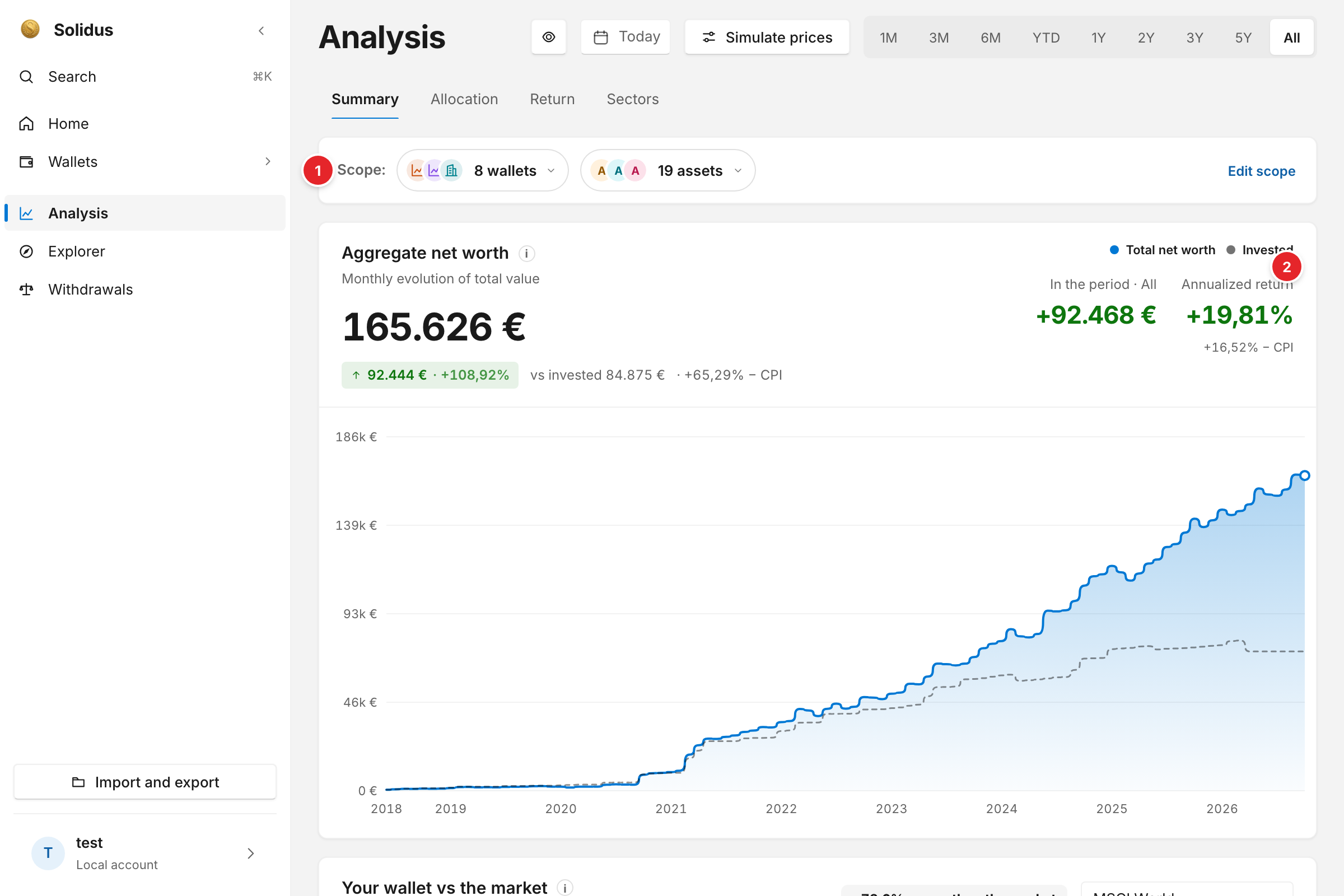
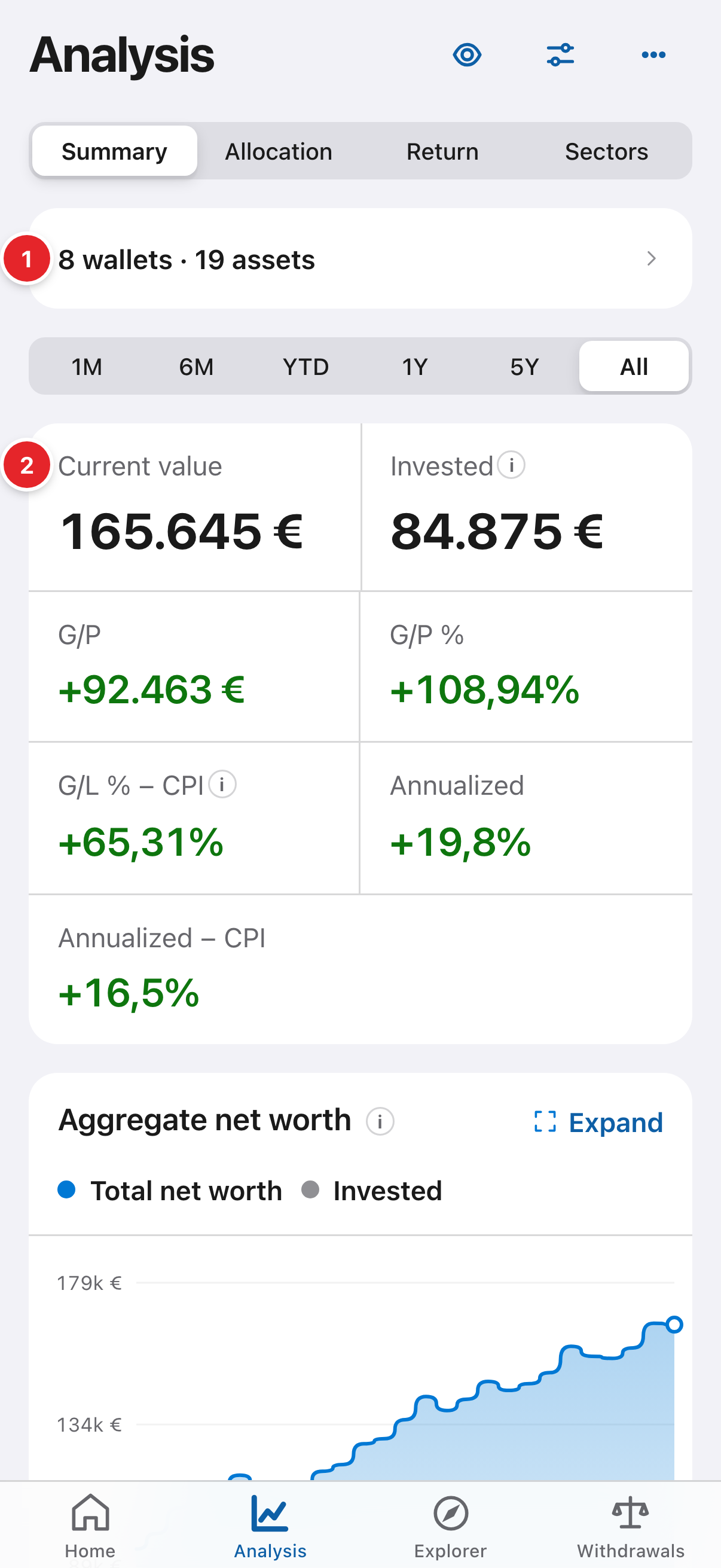
- Scope: the wallets and assets that go into the analysis.
- The summary figures: current value, G/L, annualised return and CPI, all defined below.
Screenshots are of the real app with sample data, not anyone’s own.
- Wallet
- A group of investments with its own name and currency, like a folder: “Funds”, “Crypto”, “Pension plan”. You can have as many as you like and view them separately or together in the analysis.
- Asset
- What you buy: a stock, a fund, an ETF, a cryptocurrency… Each asset is identified by its ticker and can be in several wallets at once.
- Ticker
- The code that identifies an asset and is used to download its prices. E.g.
AAPL(Apple),IWDA.AS(an ETF listed in Amsterdam),BTC-EUR(bitcoin in euros). If the ticker is misspelled, Solidus can’t find the price. - Alias
- The name you give an asset so you can recognise it in charts and lists, for example “My index fund” instead of a long code. It changes nothing in the calculations, only how you see it.
- Transaction
- Each operation you record: buy, sell, dividend, split, reinvestment, transfer… It is the only thing you enter; everything else (positions, value, return) is calculated from them.
- Position
- What you hold today of an asset in a wallet. You don’t type it: Solidus works it out by adding purchases and subtracting sales. If you bought 10 and 4 and sold 6, your position is 8 units.
- Average price
- What each unit you hold has cost you on average, fees included. If you buy 10 at €100 and another 10 at €120, your average price is €110. It is the reference for knowing whether you are up or down.
- Current value
- What your position is worth today: quantity × market price. It changes every time the price updates, even if you do nothing.
- Invested
- The money you put in from your own pocket, with fees. Sales don’t subtract from it: what you take out counts as gain or as money recovered, not as “less invested”.
- G/L
- Gain or loss: what the market added, in money. It is the current value plus anything you have already received, minus what you invested. G/L % is the same figure as a percentage of what you invested.
- CPI
- Consumer price index: inflation. Earning 3% when prices rise 2% means only a 1% gain in purchasing power, which is why “G/L % − CPI” discounts how much prices have risen.
- Annualised return (IRR)
- The yearly percentage that reconciles all your money in and out with what it is worth today. It takes into account when you put in each euro, so it makes a two-month investment and a ten-year one comparable.
- Scope
- The selection of wallets and assets that go into an analysis. If you pick only “Funds”, the charts and figures cover just that wallet; if you pick nothing, everything is included.
- Aggregate net worth
- The total value of all your wallets added together, month by month. It shows how everything you own evolves, wherever you hold it.
- Split
- Division of an asset: a company goes from 1 share to 4, for example. You hold more units at a lower price, but your money is worth exactly the same. It must be recorded so the average price stays correct.
- Reinvestment
- A dividend that, instead of staying as cash, is invested again in the same asset. It is recorded as the dividend plus the matching purchase.
- Transfer
- Moving a fund into another without selling it. The destination inherits the origin’s cost and holding period, so it isn’t treated as a sale and no capital gain is due until you sell the destination fund.
- Unrealised gain
- A gain you have on paper but haven’t realised yet. It isn’t taxed until you sell: in the meantime it can grow, shrink or disappear.
- Lot
- Each purchase of an asset, with its date and price. If you buy the same stock three times, you have three lots. They matter mostly when selling, to know which one is considered sold.
- FIFO
- First In, First Out: when selling, the units bought earliest are considered first. It is the rule used in Spain to work out which gain is taxable.
- Owner
- The person who owns a wallet. It keeps your family’s wallets apart and lets you see each person’s analysis separately.